Thursday, February 18, 2010

cartes-de-visite

Cartes-de-visite were small visiting card portraits (usually measuring 4 1/2 x 2 1/2") introduced by a Parisian photographer, Andre Disdéri, who in late 1854 patented a way of taking a number of photographs on one plate (usually eight), thus greatly reducing production costs. (He was not actually the first to produce them; this honour belongs to an otherwise obscure photographer called Dodero, from Marseilles).

Different types of cameras were devised. Some had a mechanism which rotated the photographic plate, others had multiple lenses which could be uncovered singly or all together.

In England carte-de-visite portraits were taken of Queen Victoria and Prince Albert. One firm paid a small fortune for exclusive rights to photograph the Royal Family, and this signaled the way for a boom in collecting pictures of the famous, or having one's own carte-de-visite made. It is said that the portraits of Queen Victoria and the Royal Family taken by John Mayall sold over one hundred thousand copies.

Other public figures were often persuaded to sit. Helmut Gernsheim, a writer on the history of photography, comments that they were called "sure cards" because one could be sure that each time a famous person consented to sit, a small fortune would go to the photographer! To print quickly, several negatives were taken at a sitting: the Photographic News for 24 September 1858 reported that no fewer than four dozen negatives were taken of Lord Olverston at one sitting!

During the 1860s the craze for these cards became immense. An article in the Photographic Journal, reports:

"The public are little aware of the sale of the cartes de visite of celebrated persons. As might be expected, the chief demand is for members of the Royal Fanily.... No greater tribute to the memory of His late Royal Highness the Prince Consort would have been paid than the fact that within one week of his decease no less than 70,000 of his cartes de visite were ordered...

Our great thoroughfares are filled with photographers; there are not less than thirty-five in Regent Street alone."

Sometimes the profits could be huge. A Frenchman by the name of Oliver Sarony, who was based in Yorkshire, was said to be earning more then ten thousand pounds a year - a fortune last century. Little wonder that there was speculation that Gladstone might introduce a tax on the trade!

By the way, pirating of someone else's work is not new; some firms copied the photograph of a famous person and made quite a healthy living!

The reasons for the success of these cards were

* their cheapness. The average price for a card was a shilling
* they were small, light and easy to collect, and many people began to place these in photographic albums
* collections of pictures, particularly of royalty, became highly treasured

Cartes-de-visite were Albumen prints, and it is on record that in Britain half a million eggs were being delivered yearly to one photographic studio alone!

The props used in cartes-de-visite seemed to follow certain fashions; starting off with balustrades and curtains, they moved to columns (sometimes resting on the carpet!) bridges and stiles, hammocks, palm-trees and bicycles. Sadly, quantity rather than quality was the order of the day, though there are some striking exceptions.

To some extent the carte-de-visite craze also put paid to photography in which detail was a distinctive feature; the work of Gustave Le Gray (we'll learn about him next class) and of the Bisson brothers, for example, could not be reproduced on these small cards, and thus their businesses began to fall off.

By 1860 the carte de visite craze had reached its climax. In his autobiography H. P. Robinson (also will learn about him next class) states that in 1859 his photographic business had been about to collapse, but that this innovation had saved it. By the end of 1860 he had not only paid off old debts and made additions to his premises, but had invested a considerable sum of money, two years later being able to sell his business and retire to live in London.

In May 1862, Marion & Co. announced that it had published a series of Cabinet views, 6.75 x 4.5 inches, photographed by George Washington Wilson, and the larger Cabinet photographs remained in vogue until the postcard was introduced at the turn of the century. Stereoscopic cards, whose popularity had temporarily declined, also began to experience a revival.

There are many examples of these photographs in the Royal Photographic Society's collection. Some on current display are accompanied by an advertisement by the London Stereoscopic Society, for twenty prints at one pound, "Detention 3 minutes."

text from rleggat


An original albumen contact print from a wet-plate negative. The portrait session was shot in Disderi's Paris studio. Unknown sitter.

While individual cartes de visite by him are not rare items, these uncut "proof" sheets are very difficult to find, and represent a fascinating glimpse into the world of the studio photographer in the mid-1800s.

Note there are four sets of two poses each. The images are not stereoscopic (like the ones we learned about last class and saw examples of at the No Man's Land exhibit at Rick Wester Fine Art ) they are simply 'Take 1 and Take 2'

Tintypes aka Ferrotypes

The tintype, also known as a ferrotype, is a variation on the Ambrotype, but produced on metallic sheet (not, actually, tin..usually on iron) instead of glass. The plate was coated with collodion and sensitized just before use, as in the wet plate process. It was introduced by Adolphe Alexandre Martin in 1853**, and became instantly popular, particularly in the United States, though it was also widely used by street photographers in Great Britain.

That this process appealed to street photographers was not surprising:

* the process was simple enough to enable one to set up business without much capital.
* It was much faster than other processes of the time: first, the base did not need drying, and secondly, no negative was needed, so it was a one-stage process.
* Cheap to produce
* being more robust than ambrotypes it could be carried about, sent in the post, or mounted in an album.
* The material could easily be cut up and therefore fitted into lockets, brooches, etc.

The most common size was about the same as the carte-de-visite, 2 1/4'' x 3 1/2'', but both larger and smaller ferrotypes were made. The smallest were "Little Gem" tintypes, about the size of a postage-stamp, made simultaneously on a single plate in a camera with 12 or 16 lenses.

Compared with other processes the tintype tones seem uninteresting. They were often made by unskilled photographers, and their quality was very variable. They do have some significance, however, in that they made photography available to working classes, not just to the more well-to-do. Whereas up till then the taking of a portrait had been more of a special "event" from the introduction of tintypes, we see more relaxed, spontaneous poses. Some tintypes that remain are somewhat poignant. The one shown here is of a child who has died. If this seems bizarre, it would seem to have been quite a practice in the last century.


In fact, the original name for Tintype was "Melainotype." It is perhaps worth adding that there was no tin in them. Some have suggested that the name after the tin shears used to separate the images from the whole plate, others that it was just a way of saying "cheap metal" (ie non-silver).

The print would come out laterally reversed (as one sees oneself in a mirror); either people did not worry about this, or just possibly they did not discover it until after the photographer had disappeared!***

Being quite rugged, tintypes could be sent by post, and many astute tintypists did quite a trade in America during the Civil War, visiting the encampments. Later, some even had their shop on river-boats.

Tintypes were eventually superseded by gelatin emulsion dry plates in the 1880s, though street photographers in various parts of the world continued with this process until the 1950s; the writer well remembers being photographed by one of these street photographers in Argentina, when he was a boy. Eventually, of course, 35mm and Polaroid photography were to replace these entirely.

** Professor Hamilton L. Smith was the first to make ferrotypes in the Unites States, and he and Victor Moreau Griswold introduced the process to the photographic industry.

*** Sometimes failure to recognise this has led to false assumptions. (See HERE).

Tintype process video:


John Coffer news video


text from rleggat

Ambrotypes

Ambrotype process

If a very thin under-exposed negative (this is when the negative has not been exposed long enough to fully capture a majority of the scene) is placed in front of a dark background, the image appears like a positive. This is because the silver reflects some light whilst the areas with no silver at all will appear black. This is the principle behind the Ambrotype process, the pictures being more correctly known as Collodion positives.

Ambrotypes were made from the 1850s and up to the late eighties, the process having been invented by Frederick Scott Archer in collaboration with Peter Fry, a colleague. Ambrotypes were direct positives, made by under-exposing collodion on glass negative, bleaching it, and then placing a black background - usually black velvet, occasionally varnish - behind it. Though Ambrotypes slightly resemble Daguerreotypes, the method of production was very different, and Ambrotypes were much cheaper.

The Ambrotype process was yet another method of reducing the cost of photography. It became popular for a number of reasons:

* less exposure time was needed
* production was cheaper and quicker, as no printing was required
* as the negative could be mounted the other way, by placing the collodion side on top of the backing material, there was no lateral reversal, as there was in most Daguerreotypes.
* unlike Daguerreotypes, they could be viewed from any angle

Ambrotypes became very popular, particularly in America. The process is also called "Melainotype" in the European continent.

One of you was asking if it is easy to purchase 19th century images made by the older photographic processes:


It seems like Ambrotypes are much cheaper than Daguereotypes on ebay, but I would still think that the best way to get a hold of them is going to rural thrift / antique shop as a lot of the time they are just a fraction of the cost.

text from rleggat

Collodion aka Wet Plate process

Collodion aka wet plate process

This process was introduced in 1851 by Frederick Scott Archer and marks a watershed in photography.

Up till then the two processes in use were the daguerreotype and the calotype. Daguerreotypes were better than calotypes in terms of detail and quality, but could not be reproduced; calotypes were reproducible, but suffered from the fact that any print would also show the imperfections of the paper.

The search began, then, for a process which would combine the best of both processes - the ability to reproduce fine detail and the capacity to make multiple prints. The ideal would have been to coat light sensitive material on to glass, but the chemicals would not adhere without a suitable binder which obviously had to be clear. At first, Albumen (the white of an egg) was used. Then in 1851 Frederick Scott Archer came across collodion.

Collodion was a viscous liquid - guncotton dissolved in ether and alcohol - which had only been invented in 1846, but which quickly found a use during the Crimean war; when it dried it formed a very thin clear film, which was ideal for dressing and protecting wounds. (One can still obtain this today, for painting over a cut). Collodion was just the answer as far as photography was concerned, for it would provide the binding which was so badly needed. Lewis Carroll, himself a photographer who used collodion, described the process in a poem he called "Hiawatha's Photography."

"First a piece of glass he coated
With Collodion, and plunged it
In a bath of Lunar Caustic
Carefully dissolved in water;
There he left it certain minutes.
Secondly my Hiawatha
Made with cunning hand a mixture
Of the acid Pyro-gallic,
And the Glacial Acetic,
And of alcohol and water:
This developed all the picture.
Finally he fixed each picture
With a saturate solution
Of a certain salt of Soda...."

This "soda" was, of course, hypo. Sometimes potassium cyanide was used, the advantage of this being that the solutions could be washed out by rinsing under a tap for a minute or so, whereas hypo would need much more washing time.

The collodion process had several advantages.

* being more sensitive to light than the calotype process, it reduced the exposure times drastically - to as little as two or three seconds. This opened up a new dimension for photographers, who up till then had generally to portray very still scenes or people.
* because a glass base was used, the images were sharper than with a calotype. (Glass being clear and not having any sort of texture like paper does)
* because the process was never patented, photography became far more widely used.
* the price of a paper print was about a tenth of that of a daguerreotype.

There was however one main disadvantage: the process was by no means an easy one. First the collodion had to be spread carefully over the entire plate. The plate then had to be sensitised, exposed and developed whilst the plate was still wet; the sensitivity dropped once the collodion had dried. It is often known as the wet plate collodion process for this reason.

The process was labour-intensive enough in a studio's darkroom, but quite a feat if one wanted to do some photography on location. Some took complete darkroom tents, Fenton (whose is most famous for photographing the Crimean War, we'll look at his work next class) took a caravan, and it is no mere coincidence that many photographs taken in this period happened to be near rivers or streams! Moreover, at this time there were no enlargements, so if one wanted large prints, there was no alternative but to carry very large cameras. (It is such limitations of the process that make the work of people like the Bisson brothers, Fenton, and others so remarkable).

One might also mention the safety factor. The collodion mixture was not only inflammable but highly explosive. It is reported that several photographers demolished their darkrooms and homes, some even losing their lives, as a result of careless handling of the photographic chemicals.

Despite the advantages the collodion process offered, there were still many who stoutly defended the calotype. A writer in the Journal of the Photographic Society (December 1856) wrote:

"for subjects where texture, gradations of tint and distance are required, there is nothing.... to compare with a good picture from calotype or waxed paper negative."

Moreover, the calotype process was less of an ordeal, especially for travel photographers; paper negatives could be prepared at home, exposed on location, and then developed upon one's return. Hence Diamond used the calotype process for some of his travel photographs, though he used collodion for portraiture and for his medical photography.

Nevertheless the invention of this process turned out to be a watershed as far as photography was concerned:

* cheaper alternatives, such as Ambrotypes and Tintypes were developed. The former was a positive on glass, the latter a positive on metal;
* stereoscopic photography began to flourish;
* the carte-de-visite craze started;
* because of the faster speed of the process, the analysis of movement (ex: Eadward Muybridge, whose work we will probably look at during class 4) became possible.

The use of collodion caught on very quickly indeed, and within a few years few people used either the Daguerreotype or Calotype process.

The records of the Photographic Society give an interesting account of the efforts to ensure even sensitivity of the Collodion plates. As mentioned above, these plates had to be dipped into a nitrate of silver bath and exposed whilst still wet. Exposure would have to be almost immediate as otherwise the top of the plate would lose its moisture and the sensitivity would become uneven. All sorts of liquids were tried, including honey, beer, and even rasperry syrup!

text from rleggat

Here is a video we watched in class about the wet plate process:

Hippolyte Bayard

Hippolyte Bayard
b. 1801, d. 1887
French

Experimenting during his time off from his job as a civil servant, Hippolyte Bayard purportedly invented photography earlier than Louis-Jacques Mandé Daguerre in France and William Henry Fox Talbot in England, the two men traditionally credited with its invention. Bayard was reportedly persuaded by a friend of Daguerre to postpone the announcement of his findings, thus missing the opportunity to be recognized as the inventor of the medium. In 1840 he responded to this injustice by creating perhaps the first example of political-protest photography, a portrait of himself as a drowned man, upon which he wrote:


The corpse which you see here is that of M. Bayard, inventor of the process that has just been shown to you. As far as I know this indefatigable experimenter has been occupied for about three years with his discovery. The Government, which has been only too generous to Monsieur Daguerre, has said it can do nothing for Monsieur Bayard, and the poor wretch has drowned himself. Oh the vagaries of human life...! ... He has been at the morgue for several days, and no-one has recognized or claimed him."

He continues:

"Ladies and gentlemen, you'd better pass along for fear of offending your sense of smell, for as you can observe, the face and hands of the gentleman are beginning to decay."

In fact Bayard did not drown himself but continued to photograph until his death nearly fifty years later. He was the first photographer to be granted a mission héliographique by the Commission des Monuments Historiques to document architecture in France.


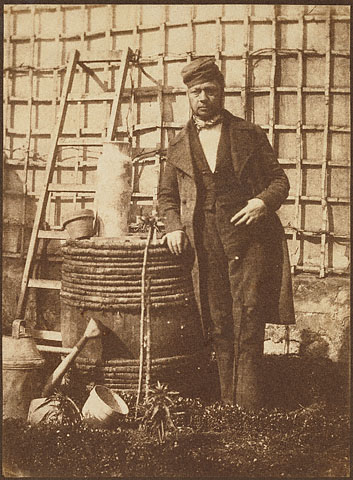
Another self-portrait by Hippolyte Bayard (1847) in the Getty Museum's Collection, this example presents Bayard as a man of the middle class. Although not dressed to plunge his hands in the earth, he looks at home in his garden, surrounded by the commonplace tools of the trade: a barrel, a rustic vase, empty terracotta pots, a watering can, a ladder, and a trellis. The beginning of a vine adorns the trellis and new growth appears at his feet, both of which suggest a new season for the garden as well as the gardener. His confident, proud stance suggests that Bayard was also a gentleman gardener very keen to identify himself with his pastime.


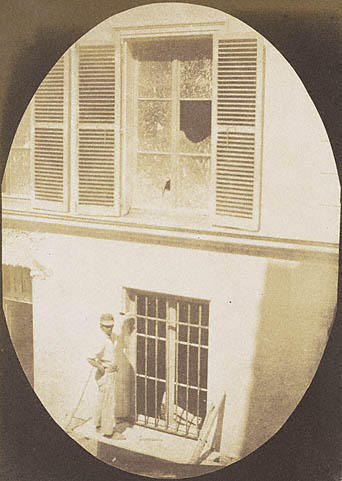
A construction worker stands below eye-level amidst the geometric structure of a two-story building. This photographic view of daily life in the 1840s was quite unusual, demonstrating Hippolyte Bayard's early interest in what later came to be considered a social-documentary approach.

Aside from his human subject, Bayard seemed drawn to the negative shapes of the broken glass pane of a shuttered window and those of the barred one below. These graphical forms support the photograph's gridlike composition, which seems curiously at odds with its gentle framing. The oval mask may have been an attempt to soften the subject's starkness, following a fine-art approach adopted by photographers in the 1800s.

Bayard made many views of Paris in the early years following photography's invention, favoring the British-invented calotype process over France's daguerreotype process. He created this photograph several years before working on a series of architectural studies for the Commission des Monuments Historiques' Mission Héliographique, a French government-sponsored project to record historic buildings around the city. It also predates Eugène Atget's atmospheric, Parisian street scenes made some fifty years later.


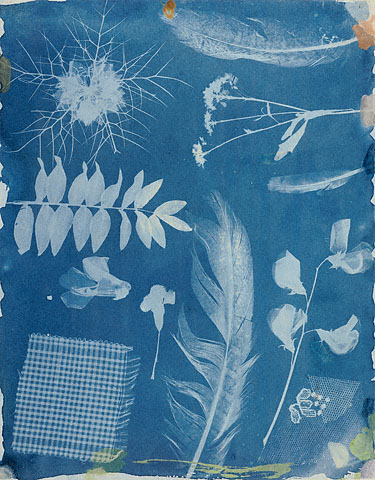
This image (1842) is an early example of a scientific fundamental of photography--the light sensitive nature of certain chemical compounds. Without the use of a camera or lens, Hippolyte Bayard carefully arranged a delicate selection of laces and flora on a sheet of paper that was made sensitive to light with a combination of iron salts that produced a blue-toned cyanotype when developed. The sheet of sensitized paper with the objects placed upon it is exposed to sunlight in order to make a camera-less photogenic drawing.

The opacity of the object blocks the light in relation to its density, thus creating a silhouette of the object on the paper. Because the process was relatively uncomplicated, cyanotypes provided a quick method of recording easily recognizable shapes and patterns. Bayard filled the entire sheet of paper, creating a catalog of specimens that reveals the basic structure of each flower, leaf, feather, and scrap of fabric.

Text from Getty

Wednesday, February 17, 2010

Amy Stein: Stranded

Friday, February 19, 2010
7:30pm - 9:30pm
55 Washington Street, No. 802, Brooklyn, NY


Photographer Amy Stein will discuss her new series Stranded and speak with renowned art critic Lyle Rexer about the themes that run between her images and Kelly Reichardt’s award winning film Wendy and Lucy.

Conversation: Lyle Rexer and Amy Stein
7:30pm - 8:15pm

The conversation will be followed by a special screening of the film. This screening is part of Caption’s current exhibit "Instruments of Empire: Photographs by Amy Stein and Brian Ulrich."

Screening: Wendy and Lucy
8:15pm - 9:30pm

Wednesday, February 10, 2010

Assignment #1

Last week we saw Timothy Briner's: Boonville show at Daniel Cooney Fine Art.


Your first assignment is to come up with 3 questions. We are going to be doing a collaborative class interview through email with Timothy that he has very graciously agreed to.

Please take a look at the photographs again and try to come up with detailed questions about the work.

Bring them in to class on Saturday.

Also, please look through the work and press releases of the other three shows we saw: Diane Arbus, William Egglston, Aaron Siskind and be prepared to discuss them in class.

Links to those works are a couple posts down.

Don't Ask Don't Tell.

With the possible overturning of the don't ask don't tell policy of the United States military, I thought this project was both an important part of our country's/photography's history as well as just visually striking.

Please take a look at both the work of Jeff Sheng and his artist statement on the website and think about

a) How much of a person do we need to see for it to be a portrait of them.

b) The relationship of the photographer to the subject in this series.

Monday, February 8, 2010

An invention of the devil brought to you by a French man.

First, the name. We owe the name "Photography" to Sir John Herschel , who first used the term in 1839, the year the photographic process became public. (*1) The word is derived from the Greek words for light and writing.

There are two distinct scientific processes that combine to make photography possible. It is somewhat surprising that photography was not invented earlier than the 1830s, because these processes had been known for quite some time. It was not until the two distinct scientific processes had been put together that photography came into being.

The first of these processes was optical. The Camera Obscura (dark room) which an Arabian scholar Ibn Al-Haythan was credited with first describing c. 1000 ad. and


There is a drawing, dated 1519, of a Camera Obscura by Leonardo da Vinci; about this same period its use as an aid to drawing was being advocated.

The second process was chemical. For hundreds of years before photography was invented, people had been aware, for example, that some colors are bleached in the sun, but they had made little distinction between heat, air and light.

* In the sixteen hundreds Robert Boyle, a founder of the Royal Society, had reported that silver chloride turned dark under exposure, but he appeared to believe that it was caused by exposure to the air, rather than to light.

* Angelo Sala, in the early seventeenth century, noticed that powdered nitrate of silver is blackened by the sun.

* In 1727 Johann Heinrich Schulze discovered that certain liquids change colour when exposed to light.

* At the beginning of the nineteenth century Thomas Wedgwood was conducting experiments; he had successfully captured images, but his silhouettes could not survive, as there was no known method of making the image permanent.

The first successful picture was produced in June/July 1827 by Niépce, using material that hardened on exposure to light. This picture required an exposure of eight hours.


On 4 January 1829 Niépce agreed to go into partnership with Louis Daguerre. Niépce died only four years later, but Daguerre continued to experiment. Soon he had discovered a way of developing photographic plates, a process which greatly reduced the exposure time from eight hours down to half an hour. He also discovered that an image could be made permanent by immersing it in salt.

Following a report on this invention by Paul Delaroche , a leading scholar of the day, the French government bought the rights to it in July 1839. Details of the process were made public on 19 August 1839, and Daguerre named it the Daguerreotype.

The announcement that the Daguerreotype "requires no knowledge of drawing...." and that "anyone may succeed.... and perform as well as the author of the invention" was greeted with enormous interest, and "Daguerreomania" became a craze overnight. An interesting account of these days is given by a writer called Gaudin , who was present the day that the announcement was made.

However, not all people welcomed this exciting invention; some pundits viewed in quite sinister terms. A newspaper report in the Leipzig City Advertiser stated:

"The wish to capture evanescent reflections is not only impossible... but the mere desire alone, the will to do so, is blasphemy. God created man in His own image, and no man- made machine may fix the image of God. Is it possible that God should have abandoned His eternal principles, and allowed a Frenchman... to give to the world an invention of the Devil?"

At that time some artists saw in photography a threat to their livelihood and some even prophesied that painting would cease to exist.

The Daguerreotype process, though good, was expensive, and each picture was a once-only affair. That, to many, would not have been regarded as a disadvantage; it meant that the owner of the portrait could be certain that he had a piece of art that could not be duplicated. If however two copies were required, the only way of coping with this was to use two cameras side by side. There was, therefore, a growing need for a means of copying pictures which daguerreotypes could never satisfy.

Different, and in a sense a rival to the Daguerreotype, was the Calotype (originally called the Talbotype) invented by William Henry Fox Talbot, which was to provide the answer to that problem. His paper to the Royal Society of London, dated 31 January 1839, actually precedes the paper by Daguerre; it was entitled "Some account of the Art of Photogenic drawing, or the process by which natural objects may be made to delineate themselves without the aid of the artist's pencil." He wrote:

"How charming it would be if it were possible to cause these natural images to imprint themselves durably and remain fixed on the paper!"

The earliest paper negative we know of was produced in August 1835; it depicts the now famous window at Lacock Abbey, his home.


The negative is small (1" square), and poor in quality, compared with the striking images produced by the Daguerreotype process.

By 1840, however, Talbot had made some significant improvements, and by 1844 he was able to bring out a photographically illustrated book entitled "The Pencil of nature."

Compared with Daguerreotypes the quality of the early Calotypes was somewhat inferior. However, the great advantage of Talbot's method was that an unlimited number of positive prints could be made. In fact, today's photography is based on the same principle, whereas by comparison the Daguerreotype, for all its quality, was a blind alley.

The mushrooming of photographic establishments reflects photography's growing popularity; from a mere handful in the mid 1840s the number had grown to 66 in 1855, and to 147 two years later. In London, a favourite venue was Regent Street where, in the peak in the mid 'sixties there were no less than forty-two photographic establishments! In America the growth was just as dramatic: in 1850 there were 77 photographic galleries in New York alone. The demand for photographs was such that Charles Baudelaire (1826-1867), a well known poet of the period and a critic of the medium, commented:

"our squalid society has rushed, Narcissus to a man, to gloat at its trivial image on a scrap of metal."

The Daguerreian Society

While mostly Daguerre, Niepce, and Talbot are most known for the invention of photography. There was another man by the name of Hippolyte Bayard who is often not given due credit.

Bayard, a Civil Servant, was one of the earliest of photographers. His invention of photography actually preceded that of Daguerre, for on 24 June 1839 he displayed some thirty of his photographs, and thus at least goes into the record books as being the first person to hold a photographic exhibition. However Francois Arago (a friend of Daguerre and who was seeking to promote his invention) persuaded him to postpone publishing details of his work. When Bayard eventually gave details of the process to the French Academy of Sciences on 24 February 1840, he had lost the opportunity to be regarded as the inventor of photography. As some recompense he was given some money to buy better equipment, but in no way did this atone for the injustice caused him.

More on the importance of Bayard and his list of firsts in class 2.

Most of this text is by Robert Leggat.

Saturday, February 6, 2010

And so it begins.

Welcome. Please check this a couple times a week as there will be reading assignments / etc.

Here are the shows we are seeing today. So much good stuff all on one street.

Aaron Siskind at Alan Klotz 511 W 25th St 7th fl Klotz Gallery

Timothy Briner at Daniel Cooney. 511 W 25th St #506 Daniel Cooney Fine Art

William Eggleston: 21st Century at Cheim & Reid. 547 W 25th St Cheim & Reid

Diane Arbus: In The Absence of Others. Also at Cheim Reid

My email: MaxTakesPhotos@yahoo.com

Wednesday, December 9, 2009

Photojournalism

Toward the end of the 19th and into the early 20th century, greater numbers of magazines were published throughout the world. The enlarged demand for photographic illustration, along with the appearance of lighter, easier-to-use camera equipment, led to an increase in images of war for reproduction.

The Spanish-American War was documented by Jimmy Hare, the South African War by Horace W. Nicholls, the Russo-Japanese War by Luigi Barzini, and the Mexican Revolution

by Agustin Victor Casasola.

Although strict censorship prevailed with regard to the photographic record of World War I, the prominence of picture magazines from the 1920s through the 1950s ensured the continuance of war reportage.

A new approach to photojournalism began to emerge with the appearance of the

Ermanox in 1924 and the

Leica in 1925.

These two German-made miniature cameras, fitted with wide-aperture lenses, required extremely short exposure times for outdoor work and were even able to photograph indoor scenes with available light. The Leica had the added advantage of using 35-mm roll film that could be advanced quickly, allowing a succession of exposures to be made of the same subject. This capability led to photographs whose informality of pose and sense of presence were remarkable. (2007 Leica article from the New Yorker)

Owing to these developments, the photojournalist was able to perceive a significant moment in a fraction of a second and to use the camera with such speed and precision that the instantaneous perception would be preserved forever.

This is evident in the work of the Hungarian André Kertész

in Paris during the 1920s.


The Frenchman Henri Cartier-Bresson began about 1930 to develop the style that he later called the search for the “decisive moment.” To him the camera was an “extension of the eye.” Preferring the miniature 35-mm-film camera, he worked unobtrusively, making numerous exposures that usually included one in which all the elements come together to form a compelling psychological and visual statement.


In 1928–29 two of the largest picture magazines in Europe, the Münchner Illustrierte Presse

and the Berliner Illustrirte Zeitung

began to print the new style of photographs. (Interesting article on photography changing magazines by Steven Heller)

Erich Salomon captured revealing candid portraits of politicians and other personalities

by sneaking his camera into places and meetings officially closed to photographers.

Felix H. Man


encouraged by Stefan Lorant, editor of the Münchner Illustrierte, made sequences of photographs at interviews and cultural and social events, which Lorant then laid out in imaginative picture essays.

The example of the German picture magazines was followed in other parts of Europe and in the United States. One was the short-lived Vu, established in Paris in 1928. An issue of Vu devoted entirely to the Spanish Civil War contained memorable photographs by Robert Capa.

(Read about accusations of what is possibly the most famous war photo being staged)

In 1936 both Life and Look were conceived in the United States, and a formula evolved in which the picture editor, photographer, researcher, and writer constituted a team.

Among Life’s first photographers were Bourke-White, already famous for her industrial photographs made largely for the magazine Fortune; Alfred Eisenstaedt

an experienced photo reporter for the Keystone Picture Agency in Germany; Hansel Mieth

also from Germany, who at times worked with her husband, Otto Hagel

and Peter Stackpole

whose photographs of the Golden Gate Bridge in San Francisco attracted much attention.

The concept of Life from the start, according to its founder, Henry Luce, was to replace haphazard picture taking and editing with the “mind-guided camera.”

Photographers were briefed for their assignments and encouraged to take great quantities of photographs so that the editors might have a large selection. The fact that selection and sequencing were a function of the editors led to objections on the part of some photographers, notably W. Eugene Smith, (Actually, they were talking about this on NPR this week during their discussion of his tapes of the jazz loft project) who left the employ of Life at one point in order to gain greater control over his own work. The visual organization of the picture story was carefully planned for maximum reader impact. The opening photograph of the photo-essay established the situation, and as with written narration there was a visual climax and a definite conclusion.

Initially Life and Look preferred to use pictures of great sharpness and depth. Thus, instead of unobtrusive miniature cameras, American photographers used large-format cameras requiring slow lenses, large plates, and additional flash light. This way of photographing was challenged by Lorant, who had left the Münchner Illustrierte Presse after being forced to leave Germany in 1934. He eventually settled in London, where he established the magazines Weekly Illustrated (1934) and Picture Post (1938). Staff photographers on both magazines included old colleagues also forced from Germany, such as Man and

Kurt Hutton.

They and other contributors were encouraged to develop the technique and pictorial style of taking photographs by using available light—i.e., not using a flash. Their pictures had a remarkable naturalness that brought great reader appeal—so much so that Life began to publish similar photographs and in 1945 hired a former Picture Post photographer, Leonard McCombe

with an extraordinary clause in his contract: he was forbidden to use a flash.

The photojournalistic style popularized by Life and Look influenced other activity in the field, in particular the exhibition “Family of Man,” which was mounted by Steichen at the Museum of Modern Art in New York City in 1955. This highly popular exhibition presented over 500 photographs—mostly photojournalistic and documentary work—alongside texts of different sizes and formats, somewhat in the manner of a three-dimensional magazine.

Memorable groups of photographs were taken for the major picture magazines. Examples are Man’s A Day with Mussolini, first published in the Münchner Illustrierte Presse (1931) and then, with a brilliant new layout, in Picture Post; Smith’s Spanish Village (1951) and Nurse Midwife (1951) in Life; and Eisenstaedt’s informal, penetrating portraits of famous Britons, also in Life. Images by Eisenstaedt of the Italian incursion into Ethiopia and by David Seymour (“Chim”) and Capa of the Spanish Civil War made visible events leading up to World War II. This conflict was thoroughly documented for the Western allies by military personnel as well as by Capa, Bourke-White, Dmitry Baltermants, Yevgeny Khaldey, and Constance Stuart Larrabee on the North African, eastern European, and western European fronts and by Smith in the South Pacific. Heinrich Hoffman portrayed the war at home and at the front for Germany, and Yosuke Yamahata

documented the role of the Japanese army in the South Pacific.

Tonight.

Join master photographer Joel Meyerowitz for a talk and book signing at The Strand Book Store on the occasion of the publication of Legacy: The Preservation of Wilderness in New York City Parks. This compelling body of work is the result of a unique commission Meyerowitz received from the New York City Department of Parks & Recreation to document, interpret, and celebrate one of the city’s greatest legacies: nearly nine thousand acres of parks in the five boroughs that still exist close to their original pristine state, as well as areas within parks that have been left to revert to wilderness.


Legacy: The Preservation of Wilderness in New York City Parks
Joel Meyerowitz: Artist’s Talk and Book Signing
Wednesday, December 9, 7 pm

FREE

The Strand Book Store
828 Broadway (@ 12th Street)
2nd floor/Art Department
New York, New York

Monday, December 7, 2009

Documentary photography

Working mainly in the opening years of the 20th century, French photographer Eugène Atget documented

shop fronts, architectural details and statuary, trees and greenery, and individuals who made their living as street vendors, producing some 10,000 photographs of Paris and its environs.

Unlike many of the architectural photographers before him, Atget showed a remarkable attention to composition,

the materiality of substances, the quality of light, and especially the photographer’s feelings about the subject matter. His work was bought mainly by architects, painters, and archivists. The visually expressive force of Atget’s work, produced with a large-format camera, is a testament to the capacity of documentation to surpass mere record making to become inspiring experience.


In like manner, although not as extensively, Czech photographer Josef Sudek created an artistic document of his immediate surroundings.

He was particularly fascinated with his home and garden, often shooting the latter through a window.

Lewis W. Hine created a similarly thorough document of a subject, in his case immigrant and working-class life in the United States.

One of the first to refer to himself as a social photographer, Hine began his documentation of immigrants at Ellis Island while still a teacher at the Ethical Culture School in New York.

Eventually he gave up teaching to work for the National Child Labor Committee, an organization of progressives seeking to make the American industrial economy more aware of its effects on individual workers.

From 1908 to 1916 Hine concentrated on photographing child workers, producing thousands of individual portraits and group scenes of underage children employed in textile mills, mines, canning establishments, and glass factories and in street trades throughout the United States. His work was effective in prompting first state regulation and eventually federal regulation of child labour.

Documentary photography experienced a resurgence in the United States during the Great Depression, when the federal government undertook a major documentary project. Produced by the Farm Security Administration (FSA) under the direction of Roy E. Stryker, who earlier had come in contact with Hine’s work, the project comprised more than 270,000 images produced by 11 photographers working for varying lengths and at different times in different places. All worked to show the effects of agricultural displacement caused by the economic downturn, lack of rain, and wasteful agricultural practices in the American South and midlands. In this project, documentation did double duty. One task was to record conditions both on nonfunctioning farms and in new homesteads created by federal legislation. Another was to arouse compassion so that problems addressed by legislative action would win support.

A portrait of a pea picker’s wife,

made by California portraitist turned documentarian Dorothea Lange, became an icon of the anxiety generated by the Great Depression.

Walker Evans was another photographer whose work for the FSA transformed social documentation from mere record making into transcendent visual expression. On leave from the FSA, Evans worked with James Agee on Let Us Now Praise Famous Men (1941; reissued 1966), a compelling look at the lives of a family of Southern sharecroppers.

Although unaffiliated with the FSA, Margaret Bourke-White, formerly one of the era’s foremost industrial photographers, also worked in the South. With her husband, writer Erskine Caldwell, she produced You Have Seen Their Faces (1937), one of the first photographic picture books to appear in softcover.


Documentary projects underwritten by other federal agencies also existed. One of more significant projects was executed by Berenice Abbott. Inspired in part by Atget’s studies of Paris, she endeavoured to photograph the many parts of New York City and to create “an intuition of past, present, and future.”

She was able to interest the Works Projects Administration (WPA) in underwriting an exhibit and publication along these lines entitled Changing New York (1939).

The German portraitist August Sander, intent on creating a sociological document of his own, generated a portrait of Germany during this period.

His focus was on the individuals composing German society, documenting a class structure with workers and farmers on the bottom. Sander’s inclusion of types not considered Aryan by German authorities brought him into conflict with the Nazi regime, which destroyed the plates for a proposed book entitled Antlitz der Zeit (“Face of Our Time”).

Among the many other amateur and professional photographers who interested themselves in the documentation of everyday life were Sergey Prokudin-Gorsky, who portrayed everyday life in Russia;


Manuel Alvarez Bravo,

who created images that offer a psychologically nuanced glimpse of Mexican life.

Robert Doisneau


Brassaï


both of whom captured vibrant images of everyday life in Paris. (Doisneau photo I used above obviously not from Paris)

Perhaps the most extensive ethnographic documentation was that of Edward S. Curtis, who produced 20 volumes of studies of Native American tribes people over the course of some 20 years.

The enormous interest in how people outside Western culture appeared and behaved was a factor in the increasing popularity of National Geographic during this period.

text from britannica

Experimental approaches

By 1916 abstract ideas were appealing to a number of other photographers. Photo-Secessionist Alvin Langdon Coburn, living in England, created a series of photographs known as vortographs, in which no subject matter is recognizable.


During the late 1910s, students and faculty at the Clarence H. White School of Photography (started by another former colleague of Stieglitz), in particular Bernard S. Horne and

Margaret Watkins, also produced works that displayed the influence of Modernist abstraction.

Between the two world wars, an experimental climate—promoted by Constructivist ideology and by Moholy-Nagy and the Bauhaus—admitted an entire range of new directions in photography. One aspect of this experimentalism involved eschewing subject matter and instead creating photographs that more closely resembled abstract paintings.

Photographers again manipulated images, experimented with processes, and used multiple images or exposures. Sometimes, rather than experimenting with the camera itself, they experimented with light and sensitized paper. For a brief time this direction was allied with Dadaist ideas about accident, chance, and the subconscious. One important exponent of photographic experimentalism was the American expatriate Dada artist Man Ray, whose “rayographs,” photographs that appeared as series of swirling abstract shapes,

were created without a camera by exposing objects placed on sensitized paper to light.

Cameraless photography, which came to be called “light graphics,” also appealed to Moholy-Nagy and his wife, Lucia Moholy, who called the products of their experimentation “photograms.” Photographs made by using this kind of manipulation of light could have completely abstract shapes or forms or feature recognizable objects. A number of artists in central Europe also manipulated light and objects to produce abstract images; among them were

Jaroslav Rössler

Gyorgy Kepes, who eventually taught at the Chicago Institute of Design. There Kepes was instrumental in introducing its methods to American photographers, among them Carlotta Corpron, who produced a series of abstractions by using a device, called a light modulator, favoured at the Bauhaus.

The manipulative strategies of photocollage and montage had considerable appeal during the interwar period in part because—by appropriating “content” from other sources—they could deal with complex political or psychological feelings and ideas. Czech and German artists were especially drawn to this type of experimentation. Herbert Bayer, Raoul Hausmann, John Heartfield, and Hannah Höch were unusually adept in their innovative use of collage and montage to make ironic comments on a range of political and social issues in German society. Heartfield,

whose work appeared on book jackets and posters, savaged the political thuggery behind the rise of Nazism by juxtaposing political imagery—for example, a stock photograph of Hitler—with unexpected, provocative imagery.

Höch concentrated on portraying the role of the “new woman” emerging in the chaos of postwar German society; for example, the title of one work by Höch,

The Cut with the Kitchen Knife, suggests a female domain, yet the image shows women freed from housewifely duties, cavorting among machinery and political figures as part of the world at large.

Similarly, montage enabled Soviet Constructivists to suggest complex ideas, as in El Lissitzky’s self-portrait,

which integrates drafting tools and geometric shapes to suggest that the artist himself was an architect of society.

text from Britannica

Paul Outerbridge


Text from Jeannine Fiedler, "Paul Outerbridge, Jr" (Schirmer/Mosel Munich)

The Olfactory Nude

During the centuries-long process of the growth of civilization, the sense of smell has more and more been excluded as something base and primitive. Although it is the primary mediator of sense impressions from our immediate vicinity, it is rarely activated during the reception of impressions from the fine arts, the gigantic flood of printed media, or even in the contemporary electronic entertainment industry. Now that the mechanical reproduction of sterile worlds of objects and images has become possible, the sense of sight, considered by Kant to be the noblest, has become the exclusive transmitter of perceptions from an environment in which visual stimuli are rampant. At the beginning of the 1930s, Outerbridge stood on the verge of the era of color reproduction - in which familiar images today range from micro-organisms to the whole of the blue planet Earth - and he was working with relatively primitive techniques of color processing. He decided to abandon the realm of black-and-white photography, which he had come to find tedious, and move forward to face the challenges of color photography. The spectrum of the gray scale associated with black-and-white photography even today, however, is associated with an element of artificiality and alienation, since it is simply an unavoidable fact that we do see and experience the world in color. In the genre of nude photography, this meant that the depiction of the human body lost its initial shock, civilization's embarrassment over naked skin, as it was mercifully concealed behind a gray veil. Outerbridge's nudes, in brilliant color reproduction and with a drastic, hitherto unparalleled realism, were seen by an American public firmly anchored in its Puritan foundations. For a society that valued ascetic ideals, it was a shock, and it caused a scandal that pushed Outerbridge, till then a successful photographer, into the commercial wilderness and ultimately meant the end of his career as a photographer.

The body, referred to by Paul Valéry as "the unique, the true, the eternal, the perfect, the insurmountable reference system", was simply terra incognita to John Doe, the average American citizen at the end of Prohibition (which also had its origins in efforts by bigoted women's associations to repress sensuality). And now came Outerbridge's women: nude photographs in color that have a haptic quality that makes the models' skin almost touchable; the eye can feel its way along delicate arterial branches under an alabaster sheen; shaved montes veneris and pudenda without the slightest retouching; delicate, pink hollows and folds - the scent of women streams from the photographs, affronting the plain soul of every good American. But for an observer prepared to go "wandering," it was an "adventure of the epidermis," exciting senses other than that of sight.

From Dandy to Playboy

"For everyone, life is an act of the body,"' as Valéry also wrote. During Outerbridge's black-and-white period in the "Golden Twenties," he produced a famous self-portrait in which he is dressed up in all the insignia of a dandy, at the same time distorting these symbols to make them grotesque - the top hat worn above a mask resembling racing driver's or diver's goggles, with an Adolphe Menjou mustache, stand-up collar, a dickey inside his tuxedo and the obligatory (canary yellow?) Baudelairean glove. Outerbridge left all the traditional views of the nude behind. From the powdered, shimmering boudoirs of the bohemian world the dandy entered the cool, satin glitter of Art Déco salons, building one himself in his studio in Nyack in upstate New York. It was here that he began his dialogue with the model he preferred - the female. The usual division of roles between the one taking photographs and the object (of desire) becomes obsolete. It is not clear who is playing with whom here. Or perhaps the photographer is simply being ignored by his model, who is stretching like Danaé in a kind of lascivious absentmindedness. Whether she is leaning against pillars or walls, looking contentedly at her image in the mirror while the male idol Clark Gable, hidden behind the mirror, shrinks to insignificance, whether she touches herself or enters into dialogue with the observer/photographer, always conscious of her own body, her own beauty - the women in Outerbridge's nudes never allow themselves to be used. This balance, which especially in this genre often tips over to women's disadvantage into a pornographic commercialization that stamps the human body with the quality of a commodity, seems not yet to be threatened here. With an absolute will to achieve structure and an obvious aesthetic pleasure on the photographer's part, and on the part of the model an equally pleasurable experience of her own body, the observer is shown not merely a "nude," but an extraordinary equilibrium of harmonious understanding. A comparable harmony between the model and the photographer is seen in E. J. Bellocq's Storyville Portraits, in which New Orleans prostitutes gaze into the camera in a similarly relaxed and self-aware way.

This establishment of a "who is being mirrored by whom?" problem is of course present as a classically psychological Narcissus motif in Outerbridge's nudes as well. But of greater significance for the interpretation of his work is the element of fetishism in it, a point we will return to below. For Outerbridge, the interest in creating an image of the human body lies in a form of the Narcissus complex, which is common to all of humanity. Julia Kristeva asserts that the mythical Narcissus has a tremendous affinity for modern humanity: "He breaks with the antique world because he makes himself the origin of seeing, and seeks the other facing him as the product of his own seeing. In this he discovers that this image is not another, but that he himself has presented it, that the other is a self-representation. In this way, and in a manner opposed to that of mysticism, Narcissus discovers in pain and in death the constitutive alienation of his own image."

A new self-awareness among women in the USA during the 1930s grew out of their increasing acceptance in the working world. Their growing share in the economic life of crisis-ridden New Deal America also encouraged their emancipation. Entertainers such as Mae West and Jean Harlow, however, with their superb, self-ironic escapades, soon had their openly erotic and even vicious statements clamped down on by the reactionary censorship of the Hays Office. The "wenches" were not to get above themselves. A parade of Hollywood divas was manufactured, and although a certain sarcastic touch could still occasionally be noted as a leftover from the earlier sexual toughness, after 1933 the "battle of the sexes" was reduced to squabbles between couples. Nevertheless, the verbal exchanges between the mixed-sex screwballs in the later comedies have never been matched in their rhetorical brilliance. What Hollywood, under official instructions, had to wrap up more subtly for prudish America continued to be dreamt about in the movie theaters; and in Outerbridge's studio on the east coast it was extrapolated into flesh and blood.

A certain "clean" or cosmetic appearance in his photographs is, on the one hand, inevitable in color photography; on the other hand, it corresponds to an aesthetics that was dominant in the USA between the wars. It is an aesthetics which, always oriented towards sales strategies, was symbiotically absorbed into advertising. In accordance with socially imposed restrictions, the naked body was frowned on; but basic capitalist attitudes and - with relaxing moral standards - ever more permissive behavior patterns in social interactions led to more and more skin appearing in advertising images. In Vargas's streamlined, almost sexless pin-ups, this aesthetic ideal reached its ultimate refinement in relation to the female body.

In the same period, photographers such as Josef Sudek or André Kertész were working on abstract, surreal distortions of their nudes, and Man Ray decorated his solarized models with an ethereal second "photoskin" and produced weightless torsos that seem to be from another world. But all of them remained bound to a tradition of nude photography that attempts to elevate the body, to transcend it, to deprive it of its nudity. It would have been unthinkable for these representatives of a black-and-white ideology to suddenly start working in color. For his time, Outerbridge was too advanced to be able to find broad public acceptance for his nude studies; his presentation of the flesh was too vivid and, like nineteenth-century erotic images, was suspected of being indecent. He produced his work for a small group of potential clients who even then were prepared to pay four-figure sums for the valuable prints.

Despite all the moral indignation and lack of understanding for Outerbridge's art during the 1930s, his brilliant realism ironically opened the way for the populist, trivial, and vulgar marketing of the female body: society was overtaken by its own lewdness. In 1953, little more than fifteen years after the first color nudes and during the mid-century period of restoration, Hugh Hefner was to start his victory march among frustrated husbands all over the world with his idea for an ever-available, unresisting Eve, shining and wrinkle-free. Where models with minds of their own took an active share in the production of fantasies (their own or others') in Outerbridge's work, Playboy degraded women into passive sex kittens. The witty, challenging aggressiveness of the screwballs and of Outerbridge's women, aware of their own bodies, was completely extinguished in the Eisenhower decade, which was fixated on traditional values: what remained were fantasies produced by men for men that excluded the female imago and alienated women from their own desires. Hefner exploited conditioned male perceptions to the utmost, using the slogan of American sales strategy "easy to consume." The blank spaces left by Outerbridge, places in which playful symbolism and fetishistic settings can release the observer's imagination, were steamrollered by the banal Playboy aesthetics. As early as 1939, the American critic Clement Greenberg published his precise definition of the "substitute culture" and kitsch that only reached its full development after the Second World War and in newly established markets in a consumer society hungry for new print media. Television was still a rare commodity. "Kitsch, using for raw material the debased and academicized simulacra of genuine culture, welcomes and cultivates this insensibility. It is the source of its profits. Kitsch is mechanical and operates by formulas. Kitsch is vicarious experience and faked sensations. Kitsch changes according to style, but remains always the same. Kitsch is the epitome of all that is spurious in the life of our times. Kitsch pretends to demand nothing of its customers except their money - not even their time."